



AI Code Intelligence.
The industry gives agents a search box. Prism gives them a navigation system.
Turn your entire codebase into a searchable, AI-ready knowledge base — for every AI coding agent and every developer on your team.

“Context files tend to reduce task success rates compared to providing no repository context, while also increasing inference cost by over 20%.”
ETH Zurich
arXiv:2602.11988, Feb 2026
The Bottleneck Isn't the Model. It's the Context.
On real enterprise codebases — 50K, 200K, 500K+ lines — both AI agents and human developers struggle with the same three failures:
We have built enterprise software for over a decade. We know this problem first-hand: outsourced teams rotate, vendors get replaced, internal restructurings dissolve entire departments. Each transition triggers weeks of handover — documentation, knowledge sessions, co-coding — without moving a single feature forward.
The knowledge is always locked in people's heads. When they leave, it leaves with them.
Both agents and developers need the same thing:
A map of the codebase that shows what matters, explains what it does, and stays current.
From Code to Intelligence. Five Stages.
The industry gives agents and developers a search box. Prism gives them a navigation system.
Every file goes through a five-stage pipeline. This powers both the MCP tools (for AI agents) and the Console (for developers). One intelligence layer, two channels.
Pulls your repository at the exact branch and commit you choose — always current, always in sync, never a stale snapshot.
Walks and classifies every file, automatically filtering out binaries, generated code, and noise.
Collects READMEs, architecture docs, and vision files, storing them as first-class context.
Extracts and indexes your coding standards and convention files, so guidance comes back in your team's own rules.
Splits source code at the AST level into functions, classes, and modules, then embeds it with a code-tuned model.
Generates a plain-language summary for every chunk: what it does, why it matters, and how it connects.
Ranks modules by structural importance using PageRank over the import graph.
Detects frameworks, languages, and project structure automatically, adapting answers to your stack.
Resolves import and dependency relationships and persists them as a full graph.
Identifies components, modules, and their capabilities, summarizing them into a structured architecture index.
Embeds the generated descriptions into a dedicated semantic layer for description-based search.
What Makes Prism Different.
LLM-Enriched Code Descriptions (Stage 3)
For every code chunk, an AI model writes a 1–2 sentence plain-English description. That description gets its own embedding — enabling two semantic search channels: Semantic (code vectors) finds code that does similar things regardless of naming, and Semantic (description vectors) finds code whose AI-generated description matches the developer's intent.
PageRank Architectural Mapping
Prism builds an import-dependency graph across the entire codebase and scores every module by structural importance. Core files imported by dozens of others rank highest; leaf utilities rank lowest. Agents and developers see the structural spine first.
Three-Tier Live Indexing
4-Way Hybrid Search A Superset of Grep and Glob.
Prism runs four search strategies in parallel and fuses the results using Reciprocal Rank Fusion. It finds everything grep and glob find — plus meaning-based matches they can't. Reciprocal Rank Fusion fuses results from all four methods. A code chunk found by multiple strategies ranks highest.
MCP Navigation Tools
Prism exposes specialised navigation tools via MCP, available to any compatible AI coding client.
Two steps: add the Prism MCP server, add an agent instruction file. Done.
No plugins, no infrastructure, no vendor lock-in.
Console Wiki & AI Architect
For human developers: a web-based Console with a living Wiki auto-generated from code and always in sync, and an AI Architect that answers any question about your codebase with code-referenced responses. No IDE required.
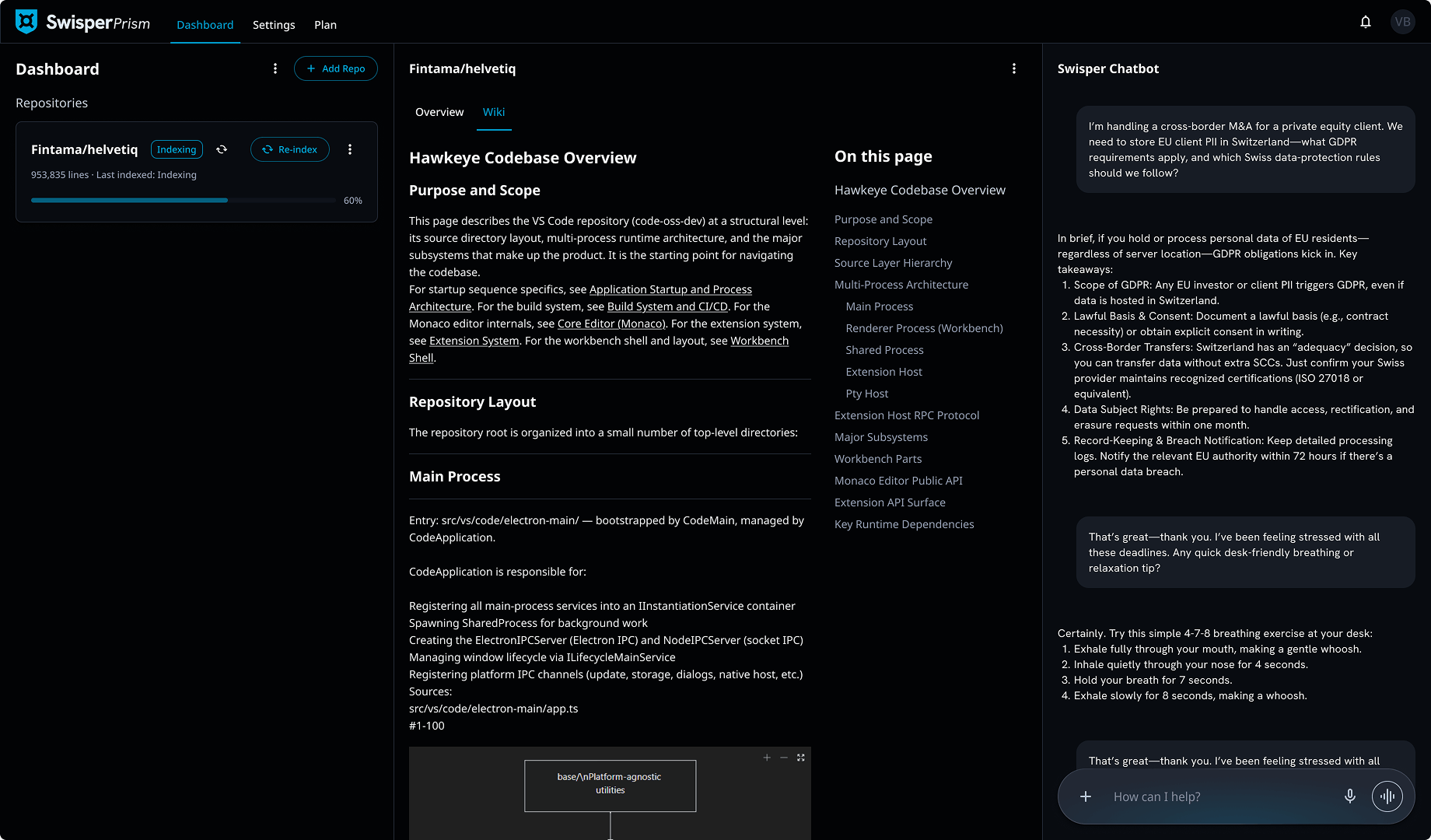
Prism Console: Dashboard, Wiki, and AI Architect
The Numbers
Benchmarked across 20 diverse coding tasks. Savings scale with codebase size.
More Reliable Output
Precise context prevents API hallucination. Confidence scores guide deeper exploration.
Faster Task Completion
Right context on the first try. Agents reason about code instead of searching for it.
Architectural Awareness
PageRank mapping means agents produce code that fits the existing architecture.
How Prism Compares
Pricing
- (Team Plan)Flat per-seat (no overages)
Credit-based (unpredictable)
Per-seat + per-review